




News Update
US Warship Hit by Missile! Why Trump Pulled Troops & What It Means
/index.php
Bisnis | Ekonomi - Posted on 22 June 2025 Reading time 5 minutes
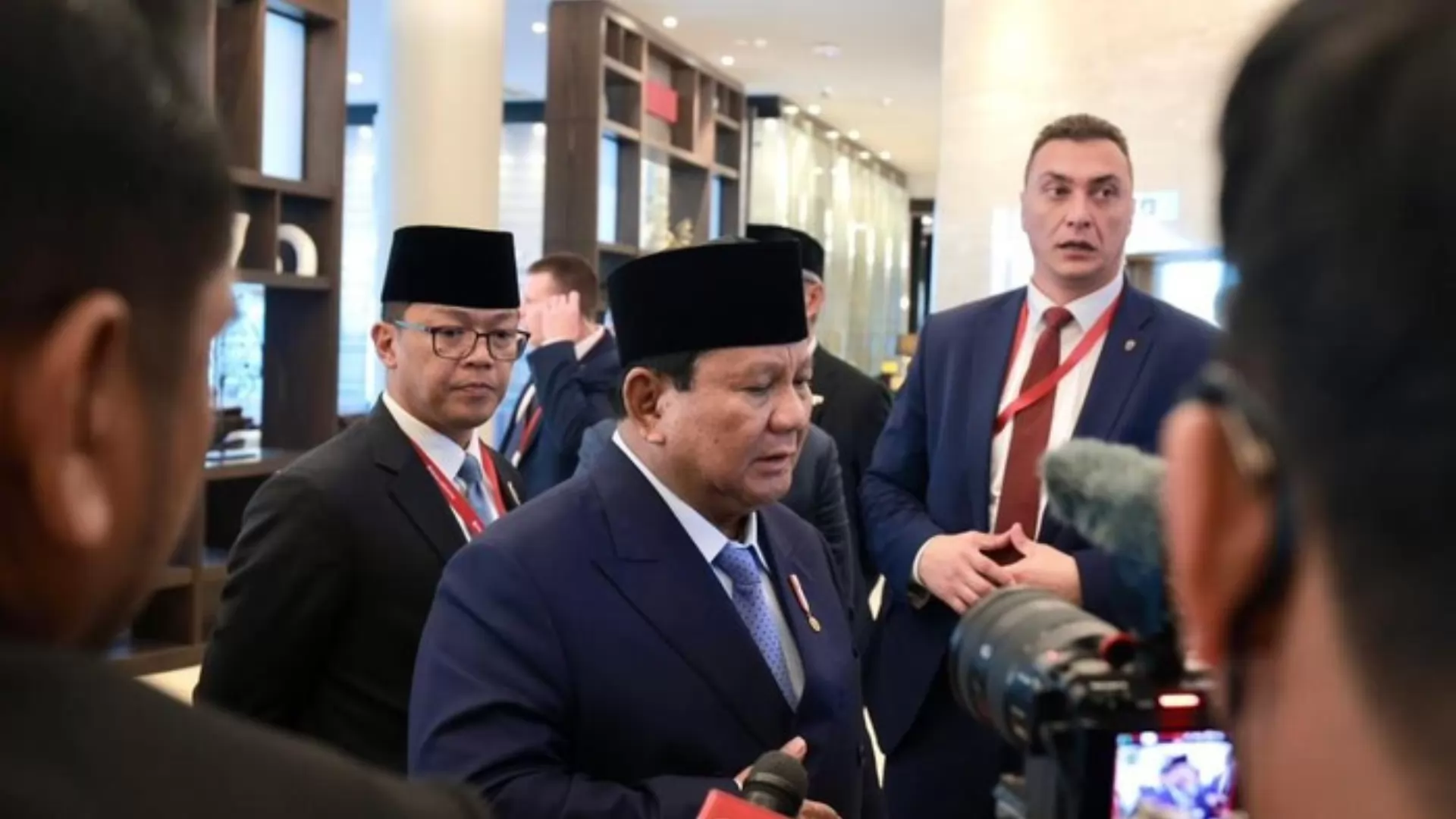
President Prabowo Subianto stated that Indonesia's economy has yet to grow evenly. According to him, only a small group of people has been able to enjoy wealth and the benefits of the country’s natural resources. This was conveyed in his speech at the St. Petersburg International Economic Forum (SPIEF) 2025, where he shared the stage with Russian President Vladimir Putin.
Prabowo highlighted that unequal economic growth is not only experienced by Indonesia but also by several Southeast Asian nations. Based on his observations, one of the major mistakes made by many countries in the region is their tendency to follow the world's strongest and most powerful forces.
This has led to the dominance of classical free-market economic philosophies, particularly the principle of laissez faire, which emphasizes minimal government interference in the economy. Such a mindset has resulted in uneven economic development across Southeast Asia, including Indonesia. Prabowo acknowledged that many Indonesian elites have historically embraced these economic ideas, often quietly.
“Over the past 30 years, we’ve seen the rise of classical capitalist free-market ideologies, and neoliberalism, which essentially lean towards laissez faire economics. Indonesian elites have followed this school of thought, and as a result, in my opinion, we’ve failed to achieve equitable prosperity for all of our people,” said Prabowo during his virtual speech on Saturday, June 21, 2025.
He elaborated that although Indonesia has managed to sustain economic growth above 5% for the past seven years, this progress has not been evenly distributed. The idea of a trickle-down effect, where wealth gradually spreads to lower income groups, has not materialized, as the majority of the benefits remain with less than 1% of the population.
“We’ve experienced significant growth—5% consistently, especially over the past seven years, which means 35% in total. Yet, we haven’t achieved the so-called trickle-down effect. Wealth continues to concentrate at the top, enjoyed by less than 1% of the population. I don’t think that’s a formula for true success,” he asserted.
The President emphasized that each country should have an economic philosophy aligned with its own cultural identity and social values, rather than simply mimicking global powers.
Under his administration, Prabowo explained, Indonesia will implement a middle-path economic system, combining elements of capitalism and socialism.
He noted that Indonesia will embrace the creativity and innovation of capitalist mechanisms to stimulate economic activity. At the same time, government intervention will remain essential to combat poverty, address hunger, and protect the vulnerable.
“We are pursuing a middle path. We want to harness the creativity, innovation, and initiative of capitalism—because we clearly need that. But we also require government involvement to eliminate poverty, to address hunger, and to safeguard the weak,” Prabowo stated.
The former general emphasized that his administration will strive to deliver the greatest good for the greatest number of people, and committed to running a clean and corruption-free government.
“We have chosen a philosophy that can be simply summarized in one sentence: ‘The greatest good for the greatest number.’ That is our guiding principle,” concluded Prabowo.
Source: detik.com
What do you think about this topic? Tell us what you think. Don't forget to follow Digivestasi's Instagram, TikTok, Youtube accounts to keep you updated with the latest information about economics, finance, digital technology and digital asset investment.
DISCLAIMER
All information contained on our website is summarized from reliable sources and published in good faith and for the purpose of providing general information only. Any action taken by readers on information from this site is their own responsibility.
SHARE
VIEW


